



The Impact of Collaborative Robotics on Industrial Operations
(Source: Novedge)
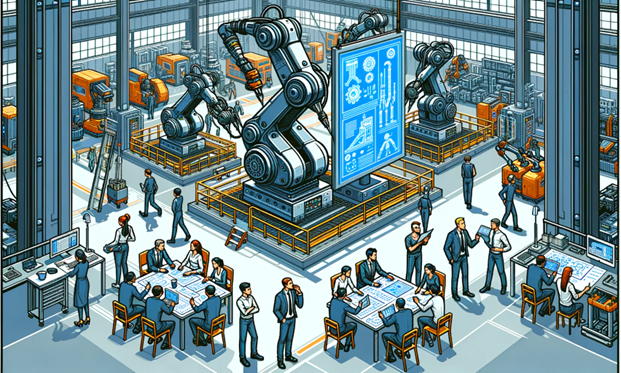
Industrial engineering is experiencing rapid transformation as manufacturing industries increasingly adopt collaborative robotics, also known as cobots. Unlike traditional industrial robots that operate separately from human workers, collaborative robots are designed to work directly alongside humans in shared workspaces. This development has become one of the most important emerging topics in industrial engineering because it combines automation, ergonomics, productivity improvement, and human-centered manufacturing systems.
The rise of collaborative robots is closely related to the evolution from Industry 4.0 to Industry 5.0. Industry 4.0 mainly emphasized automation and digital integration, while Industry 5.0 introduces stronger collaboration between humans and intelligent machines. Researchers explain that the goal of Industry 5.0 is not to replace human workers entirely, but rather to combine human creativity and flexibility with robotic precision and efficiency. This approach allows industries to achieve higher productivity while maintaining worker involvement in manufacturing operations.
Collaborative robots are increasingly used in assembly operations, material handling, quality inspection, packaging, and repetitive manufacturing tasks. In many factories, cobots assist workers by performing physically demanding or repetitive activities, reducing worker fatigue and improving workplace safety. Studies published in Robotics and Computer-Integrated Manufacturing indicate that human-robot collaboration systems significantly improve operational flexibility because robots can adapt to dynamic production environments more effectively than traditional automation systems.
One important advantage of collaborative robotics is ergonomic improvement. Industrial engineers have long focused on reducing musculoskeletal injuries and improving workplace design. Human-robot collaboration enables workers to avoid repetitive lifting, awkward movements, and hazardous operations. Recent research highlights that collaborative robotic systems can reduce physical workload while maintaining high production efficiency. As a result, industries are increasingly viewing cobots not only as productivity tools but also as solutions for occupational health and safety management.
Artificial intelligence also plays an important role in collaborative manufacturing systems. Modern cobots use AI-based vision systems, machine learning, and sensor technologies to recognize human movements and respond safely in real time. Intelligent robotic systems can detect worker positions, predict movement patterns, and adjust robotic actions accordingly. According to recent studies, AI-driven collaborative robots are becoming more adaptive and capable of learning from human behavior, making manufacturing systems more flexible and responsive.
Another emerging issue in industrial engineering is workforce adaptation in collaborative manufacturing environments. As industries adopt advanced robotics, engineers and workers must develop new technical competencies related to robotics operation, system monitoring, and human-machine interaction. Researchers emphasize that future industrial workers will require interdisciplinary skills that combine engineering knowledge, digital literacy, and problem-solving abilities. Therefore, education and workforce training have become essential components of successful human-robot collaboration implementation.
Small and medium-sized enterprises (SMEs) are also beginning to adopt collaborative robotics due to decreasing technology costs and easier system integration. Previously, industrial robots were mainly used by large manufacturing corporations because of their high investment costs and complex infrastructure requirements. However, modern collaborative robots are more affordable, flexible, and user-friendly, enabling SMEs to improve operational performance without requiring fully automated production lines. This trend is expected to accelerate the digital transformation of manufacturing industries worldwide.
Despite these benefits, several challenges remain in implementing collaborative robotic systems. Safety remains one of the primary concerns because humans and robots operate in close proximity. Industrial engineers must design manufacturing systems that ensure safe interaction through sensors, safety algorithms, and ergonomic workspace layouts. In addition, organizational resistance, high initial investment costs, and integration difficulties continue to affect adoption rates in some industries. Researchers note that successful human-robot collaboration requires not only advanced technology but also effective operational management and workforce acceptance.
Overall, human-robot collaboration represents one of the most significant future directions of industrial engineering. Collaborative manufacturing systems combine productivity improvement, workplace safety, operational flexibility, and human-centered design principles. As industries continue moving toward intelligent and adaptive manufacturing environments, industrial engineers will play an essential role in designing systems where humans and robots can work together efficiently, safely, and sustainably.
References:
- Malik, A. A., et al. (2026). Human–Robot Collaboration in Smart Manufacturing: Challenges and Future Directions. The International Journal of Advanced Manufacturing Technology. Published February 2026.
- Rossi, M., et al. (2026). Collaborative Robotics for Flexible Manufacturing Systems. Robotics and Computer-Integrated Manufacturing. Published March 2026.
- Kim, S., & Lee, H. (2026). Ergonomic Benefits of Human–Robot Collaboration in Assembly Operations. Applied Sciences. Published January 2026.
- Frontiers in Robotics and AI. (2026). Artificial Intelligence for Adaptive Human–Robot Collaboration. Published March 2026.
- Wang, Y., et al. (2026). Human-Centered Industry 5.0 Manufacturing Systems. Journal of Intelligent Manufacturing. Published March 2026.
- Bortolini, M., et al. (2026). Skills and Workforce Transformation in Collaborative Manufacturing. International Journal of Production Research. Published February 2026.
- World Economic Forum. (2026). How Collaborative Robots Are Transforming Modern Factories. Published February 2026.
- Nature Machine Intelligence. (2026). Safe Human–Robot Interaction in Industrial Environments. Published March 2026.

Comments :