

Industry 5.0
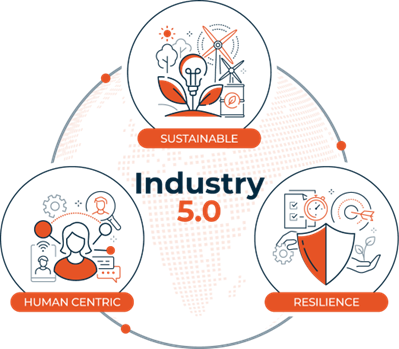
(Source: momenta.vc)
What is Industry 5.0?
Industry 5.0 is a human-centric industrial revolution. It is the next phase of the fourth industrial revolution, which we’ve seen in the last decade or so. This evolution supports human creativity and promotes mechanized efficiency, creating an ecosystem where people and machines can work together more effectively to solve problems faster than ever.
In 2020, the CODIV-19 pandemic swept around the globe. The resulting economic turbulence created an environment ripe for Industry 5.0 to take root and grow stronger than ever. While Industry 4.0 had already established a base in manufacturing, logistics, and supply chain management by implementing smart machines that make decisions based on real-time data, Industry 5.0 is now getting more traction worldwide. It has an impact on every industry, every company, every department.
A new phase of the industrial revolution
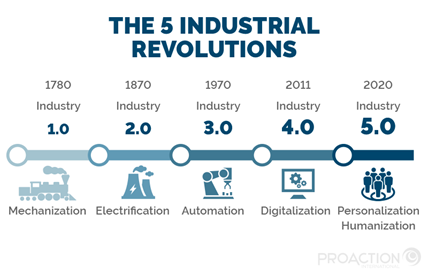
(Source: momenta.vc)
Industry 5.0 is changing how we work, live, play, and learn. It brings the principles of Industry 4.0 a step further into automation, connected devices, AI systems, robotics, and human-machine collaboration.
The driving factor of Industry 4.0 was the digitalization of information, which allowed people to access and share data in new ways. Industry 5.0 is the next step in this evolution, where we see an exponential increase in connectivity between people, machines, and data that unlocks previously untapped value (Jean-Philippe Raiche, 2023).
How the Industry 5.0 concepts emerged
Learning about the Industry 5.0 concepts and the history of this term can indeed be somewhat confusing. Especially since it tends to overlap with Industry 4.0, not just in terms of technologies and solutions but also from the temporal perspective.
The concept of Industry 4.0 is several years ahead, of course, but not for very long. It is considered that Industry 4.0 started trending in 2011, when the vision for the Fourth Industrial Revolution was presented at the Hannover Messe fair in Germany. Naturally, the initial vision of Industry 4.0 was also developed primarily for the German industrial automation and smart manufacturing market, as well as for other countries that are part of the EU and are subject to EU legislation. And even though soon Industry 4.0 became a global trend, for some time it had been perceived as primarily relevant to the European business environment and policies.
Industry 5.0, on the other hand, had a more global and international reputation from the very beginning. The origins of this concept, however, can also be traced back to Germany. It was at the CeBIT 2017 trade fair in Hannover where Japan presented its own vision for the future of industrial automation, robotics and smart manufacturing. Then, it was called Society 5.0. Reportedly, the Japanese vision gave birth to the concept of Industry 5.0 as an evolution of the original concept with enhanced role of humans, delivering business value alongside robots.
Recent experience of global COVID-19 pandemic and economic turbulence associated with it is another notable factor that played a big role in the rising popularity of Industry 5.0 as a new technology trend. A large supply of new data from companies that were implementing Industry 4.0 solutions and practices—prior to and during the COVID-19 crisis—shed light on many shortcomings of this concept and revealed areas that clearly required transformation.
Industry 5.0 vs. Industry 4.0. What’s the difference?
So Industry 5.0 is gaining momentum right now as a post-pandemic take on the future of industrial automation. In this vision, robots, smart machines, IoT, AI and Big Data are still the key to business success, but the technological side is balanced with more focus on sustainability, resilience and enhancement of human talent, supported by increasingly intelligent and efficient devices.
As you can see, the concepts of Industry 5.0 and Industry 4.0 do intersect quite a lot. What you probably can’t see right now is how they are actually different from each other and what the Industry 5.0 trend is bringing to the table. The best way to clarify this is to compare these two technological concepts to each other (Christian Berg, 2022).
References:
- Christian Berg. (2022). What is Industry 5.0? (In-depth guide with examples). Retrieved from www.clarify.io
- Jean-Philippe Raiche. (2023). Industry 5.0: Revolutionizing Work by Putting People First. Retrieved from blog.proactioninternational.com

Comments :