


Redefining Industrial Engineering Through Smart Manufacturing and AI
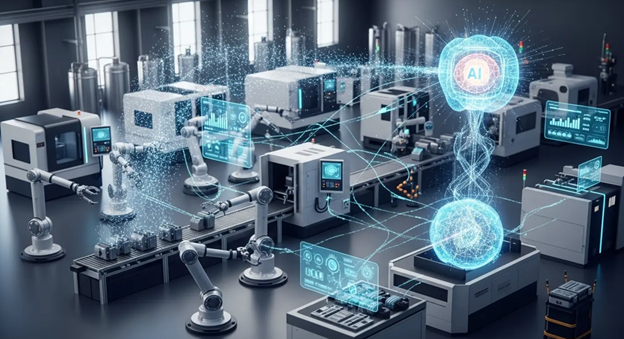
Source: widya.ai
Manufacturing Industry Transformation in the Digital Era
The manufacturing industry is experiencing one of the biggest transformations in modern history. Industrial engineering, once heavily focused on production efficiency and workflow optimization, has evolved into a multidisciplinary field that combines technology, data analytics, automation, and strategic decision-making. Global economic uncertainty, geopolitical instability, fluctuating trade policies, and rapid technological advancement are forcing companies to rethink how they design and manage industrial operations. As a result, industrial engineers are becoming increasingly important in helping organizations adapt to this new industrial landscape.
According to Deloitte’s 2026 manufacturing industry outlook, the manufacturing sector faced significant challenges throughout 2025 due to rising operational costs, declining manufacturing construction activity, and unstable trade environments. More than 75% of manufacturers identified policy uncertainty and tariffs as their primary business concern. These conditions have shifted industrial priorities from simply reducing costs toward building operational resilience and long-term adaptability. Companies are no longer asking only how to produce goods faster and cheaper; they are asking how to maintain stability in an unpredictable global environment.
Digital transformation has become the foundation of this shift. Technologies such as cloud computing, Internet of Things (IoT), artificial intelligence, and real-time analytics are now integrated into manufacturing systems to create smarter and more responsive operations. Industrial engineering plays a central role in connecting these technologies with operational processes. Engineers are now expected to understand both technical production systems and digital infrastructure. The ability to analyze data, optimize workflows, and coordinate technology integration has become essential in modern manufacturing environments.
This transformation also changes the career landscape for industrial engineers. Traditional roles such as production planner or quality control engineer are evolving into positions like supply chain analyst, industrial data specialist, and AI operations strategist. Industrial engineering is no longer confined to factory floors; it has expanded into strategic business operations where technology and operational intelligence work together. The future of industrial engineering lies in creating systems that are not only efficient but also agile, adaptive, and sustainable in the face of global uncertainty.
Smart Manufacturing dan Peran Agentic AI
Smart manufacturing has emerged as one of the most important concepts shaping the future of industrial engineering. It refers to the integration of advanced digital technologies into manufacturing systems to improve productivity, flexibility, and operational performance. Through interconnected machines, automated systems, and real-time monitoring, smart manufacturing allows organizations to make faster and more accurate decisions. Instead of relying on delayed reports and manual data collection, companies can now access live operational data directly from production systems.
Deloitte reported that approximately 80% of manufacturing leaders plan to allocate at least 20% of their improvement budgets toward smart manufacturing initiatives. These investments include automation systems, cloud-based infrastructure, advanced analytics, and sensor technology. Smart manufacturing provides several advantages, including increased throughput, higher workforce productivity, reduced downtime, and improved operational visibility. From an industrial engineering perspective, these technologies enable companies to optimize production systems while maintaining flexibility in changing market conditions.
One of the most transformative technologies supporting smart manufacturing is Agentic AI. Unlike conventional AI systems that operate within fixed instructions, agentic AI can independently reason, plan, and make operational recommendations. This technology is expected to reshape industrial operations between 2025 and 2028 by automating decision-making processes across multiple business functions. According to the Deloitte report, agentic AI can identify alternative suppliers during disruptions, automate operational reports, accelerate equipment diagnostics, and preserve institutional knowledge as experienced workers retire.
The rise of agentic AI also introduces the concept of physical AI, where autonomous robotics and intelligent machines collaborate directly with human workers. Nearly one-quarter of manufacturers surveyed expect to adopt physical AI technologies within the next two years. For industrial engineers, this creates both opportunities and challenges. Engineers must now understand how to integrate AI systems into workflows while ensuring operational safety, efficiency, and workforce adaptability. The future factory will not replace humans entirely; instead, it will create collaborative environments where humans and intelligent systems work together to improve overall productivity and innovation.
Supply Chain Transformation and Technology InvestmentSupply Chain dan Investasi Teknologi
Supply chain management has become one of the most critical aspects of industrial engineering in the modern era. Recent global disruptions demonstrated how vulnerable international supply chains can be when faced with trade conflicts, geopolitical tensions, transportation issues, and fluctuating regulations. As a result, companies are redesigning their supply chain strategies to improve resilience rather than focusing solely on cost efficiency. Industrial engineers are playing a major role in this transformation by developing systems capable of responding quickly to disruptions while maintaining operational continuity.
Deloitte’s report highlighted that nearly 78% of manufacturers still consider trade uncertainty their biggest operational risk entering 2026. To address this challenge, many organizations are investing in digital supply chain technologies powered by artificial intelligence and predictive analytics. These systems can detect potential disruptions caused by tariffs, extreme weather, or geopolitical instability before they significantly impact operations. Advanced AI tools can also evaluate financial risks, recommend alternative transportation routes, and suggest backup suppliers in real time.
Digital supply chain systems are becoming increasingly autonomous. Agentic AI technologies now allow supply chains to automatically notify decision-makers about operational risks and even initiate supplier negotiations pending human approval. This level of automation significantly improves responsiveness and reduces delays in critical decision-making processes. From an industrial engineering standpoint, these technologies improve visibility across the entire supply network while supporting better resource planning and inventory management.
Technology investment is also accelerating across manufacturing sectors, particularly in semiconductors and data center infrastructure. Deloitte noted that private-sector commitments to semiconductor manufacturing exceeded $500 billion by mid-2025. This growth is creating substantial opportunities for industrial engineers in facility planning, capacity optimization, logistics design, and operational management. At the same time, reshoring initiatives are encouraging companies to relocate manufacturing operations closer to domestic markets to improve supply chain security and operational stability. Industrial engineers are increasingly responsible for designing highly automated, energy-efficient, and digitally integrated facilities capable of supporting future industrial demands.
Workforce Challenges in the AI-Driven Industrial EraSDM Teknik Industri di Era AIServices: Agentic AI to Transform Customer Experience
The rapid adoption of digital technologies and artificial intelligence is transforming workforce requirements across the manufacturing industry. Companies now need employees who can work effectively alongside advanced technologies while adapting to continuous operational changes. This shift is particularly important for industrial engineering professionals, whose responsibilities now extend beyond process optimization into data analysis, digital system integration, and technology management.
According to Deloitte, more than one-third of manufacturing executives expressed concern about the challenge of upskilling workers to operate advanced digital systems effectively. Many organizations struggle to find employees who possess both technical engineering expertise and digital competencies. As a result, companies are increasingly adopting a “build, buy, or borrow” talent strategy. This approach involves training existing employees, recruiting specialized experts, and utilizing temporary or contract professionals to fill operational gaps.
For industrial engineering students and professionals, this trend highlights the importance of multidisciplinary skills. Technical knowledge alone is no longer sufficient in modern industrial environments. Future industrial engineers must also understand data analytics, AI systems, automation technologies, and digital operations management. Adaptability, problem-solving ability, and continuous learning are becoming just as important as traditional engineering competencies.
Despite the rapid advancement of automation, human involvement remains essential in industrial systems. Artificial intelligence can analyze data and automate repetitive decisions, but strategic thinking, creativity, leadership, and ethical judgment still require human capabilities. Industrial engineering remains uniquely positioned at the intersection of technology and human systems. Engineers must ensure that technological innovation improves operational performance without sacrificing workforce well-being, organizational culture, or long-term sustainability.
The future industrial workforce will likely involve close collaboration between humans and intelligent systems. Industrial engineers will not simply operate machines; they will design, optimize, and manage integrated systems that combine digital intelligence with human expertise. Organizations that successfully balance technology adoption with workforce development will be better positioned to compete in the evolving industrial landscape of 2026 and beyond.
Conclusion
Industrial engineering is entering a new era shaped by smart manufacturing, digital supply chains, agentic AI, and large-scale technology investment. These developments are fundamentally transforming how manufacturing systems operate and how organizations respond to global uncertainty. Modern industrial systems are no longer focused solely on efficiency; they must also prioritize resilience, flexibility, and adaptability.
Smart manufacturing technologies and AI-driven systems are creating new opportunities for industrial engineers to play strategic roles in organizational growth and innovation. Engineers who can integrate technology, operations, and human systems effectively will become increasingly valuable in future industrial environments. The ability to combine technical expertise with digital intelligence will define the next generation of industrial engineering professionals.
As industries continue evolving toward automation and intelligent systems, industrial engineering will remain one of the most critical disciplines supporting sustainable industrial growth. Companies that embrace technological transformation while continuing to invest in workforce development will gain a stronger competitive advantage in the increasingly complex global manufacturing sector.
Reference:
- McKinsey & Company. (2025). The Future of Smart Manufacturing: AI, Automation, and Industrial Resilience. McKinsey Insights. mckinsey.com

Comments :