


AI Data Centers Create New Challenges for Indonesia’s Electronics Industry
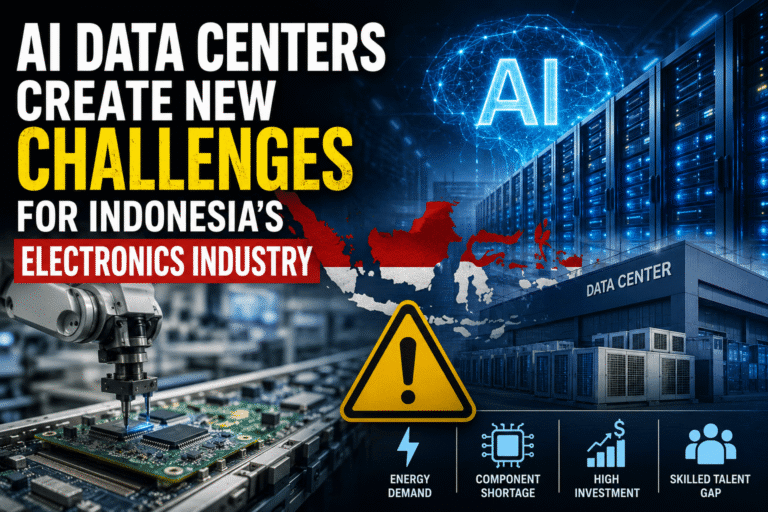
The rapid growth of artificial intelligence (AI) has significantly increased the demand for data centers around the world. Companies are investing heavily in AI infrastructure to support technologies such as generative AI, machine learning, and cloud computing. However, this expansion has also created unexpected challenges for the electronics industry. One of the biggest concerns is the global shortage of high-performance memory components, particularly DRAM (RAM) and NAND flash storage (SSD), as manufacturers prioritize supplying AI data centers over consumer electronics.
Indonesia’s electronics industry is among the sectors affected by this situation. Many local manufacturers and distributors depend on imported memory and storage components for products such as laptops, desktop computers, servers, and other electronic devices. As global demand for AI hardware continues to grow, the prices of these components have increased while their availability has become more limited. This makes it more difficult for Indonesian companies to maintain competitive production costs and stable product prices. The shortage also affects consumers. Rising component prices can lead to more expensive electronic products, including personal computers, storage devices, and business servers. For companies that require IT infrastructure upgrades, higher hardware costs may delay digital transformation projects. Small and medium-sized enterprises (SMEs), which often operate with limited budgets, are especially vulnerable because they may postpone technology investments due to increasing equipment prices.
The main reason behind this shortage is the enormous amount of memory required by AI data centers. Modern AI servers require significantly more DRAM and high-speed storage than traditional servers to process and train large language models. As a result, major memory manufacturers are allocating a larger portion of their production capacity to hyperscale AI companies, leaving fewer components available for other industries. Industry analysts predict that AI data centers could consume the majority of global DRAM production in the coming years. To respond to these challenges, Indonesian electronics companies need to strengthen their supply chain strategies. Diversifying suppliers, securing long-term procurement contracts, and improving inventory planning can help reduce the risks associated with component shortages. Companies should also focus on designing products that use components more efficiently while remaining competitive in terms of performance and cost. These strategies can improve resilience during periods of global supply disruption.
At the same time, Indonesia should continue investing in its domestic semiconductor ecosystem and digital infrastructure. Although producing advanced memory chips requires substantial investment and sophisticated technology, developing supporting industries, strengthening research collaborations, and attracting semiconductor investments can reduce dependence on imported components over the long term. Building a stronger local technology ecosystem will also support Indonesia’s ambition to become an important player in the regional digital economy. In conclusion, the rapid expansion of AI data centers is creating new opportunities for technological advancement but also placing considerable pressure on the global electronics supply chain. For Indonesia, shortages of RAM and storage components can increase production costs, raise product prices, and slow industrial growth. By strengthening supply chain management, encouraging innovation, and investing in domestic technology capabilities, Indonesia’s electronics industry can become more resilient in facing the changing demands of the AI era.
References:
- Business Insider. (2026, June 30). The memory shortage is expected to get even worse. https://www.businessinsider.com/ai-data-centers-making-memory-shortage-worse-2026-6
- Tom’s Hardware. (2025). Adata chairman says AI datacenters are gobbling up hard drives, SSDs, and DRAM alike: Insatiable upstream demand could soon lead to consumer shortages. https://www.tomshardware.com/tech-industry/big-tech/adata-chairman-says-ai-datacenters-are-gobbling-up-hard-drives-ssds-and-dram-alike-insatiable-upstream-demand-could-soon-lead-to-consumer-shortages
- Windows Central. (2026). AI-driven RAM shortages threaten more than just the PC market: Datacenters expected to consume 70% of global memory in 2026. https://www.windowscentral.com/hardware/memory-shortage-2026-tech-ai-datacenters

Comments :