


The Role of Artificial Intelligence in Enhancing Supply Chain Resilience in the Industry 5.0 Era
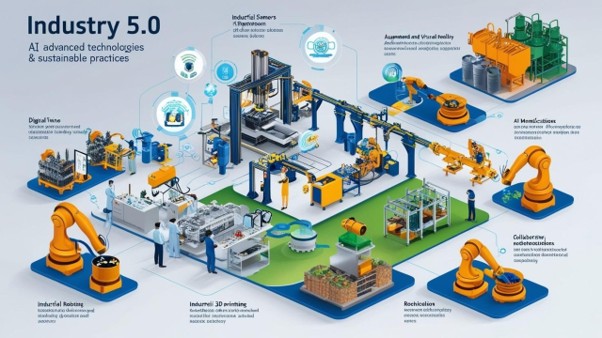
(Source: media.licdn.com)
The rapid advancement of digital technologies has transformed how companies manage their supply chains. In recent years, global disruptions such as pandemics, geopolitical conflicts, and economic uncertainty have highlighted the importance of building supply chains that are not only efficient but also resilient. As a result, the concept of Industry 5.0 has emerged, emphasizing the integration of advanced technologies with human-centered, sustainable, and resilient industrial systems.
Among the technologies driving this transformation, Artificial Intelligence (AI) plays a significant role. AI enables organizations to analyze large volumes of data, predict market trends, optimize inventory levels, and respond quickly to potential disruptions. Therefore, AI has become a key enabler in developing resilient and adaptive supply chains.
Artificial Intelligence refers to computer systems capable of performing tasks that typically require human intelligence, such as learning, reasoning, and decision-making. In supply chain management, AI processes data from various sources, including sales records, inventory databases, supplier information, and market conditions, to support operational decisions.
Several applications of AI in supply chain management include:
- Demand Forecasting
AI-powered forecasting models can analyze historical sales data and market trends to predict future demand more accurately. This capability helps organizations reduce forecasting errors and improve production planning.
- Inventory Optimization
AI assists companies in maintaining optimal inventory levels by balancing stock availability with storage costs. As a result, businesses can minimize both stockouts and excess inventory.
- Route Optimization
Transportation and logistics operations can benefit from AI by identifying the most efficient delivery routes. This reduces fuel consumption, transportation costs, and delivery times.
- Risk Detection and Mitigation
AI systems can monitor real-time data and identify potential risks, such as supplier delays, natural disasters, or market fluctuations. Early detection allows companies to take preventive actions before disruptions significantly impact operations.
Unlike Industry 4.0, which primarily focuses on automation and digitalization, Industry 5.0 emphasizes collaboration between humans and intelligent technologies. The concept is built upon three main pillars: human-centricity, sustainability, and resilience. In this context, AI does not replace human workers but supports them in making better decisions. Human expertise combined with AI-driven insights enables organizations to respond more effectively to unexpected events. For example, AI may identify supply chain disruptions and recommend alternative suppliers, while managers evaluate the recommendations and make strategic decisions.
Furthermore, resilient supply chains are increasingly important as businesses operate in a highly interconnected global environment. By leveraging AI technologies, companies can improve visibility, flexibility, and responsiveness across their supply networks. Despite its benefits, implementing AI in supply chain management presents several challenges. One major challenge is data quality. AI systems require accurate and reliable data to generate meaningful insights. Poor-quality data can lead to inaccurate predictions and ineffective decisions.
Another challenge is the high cost of technological investment. Small and medium-sized enterprises may face difficulties adopting AI due to limited financial resources. Additionally, organizations must invest in employee training to ensure that workers possess the necessary digital skills to utilize AI effectively. Data privacy, cybersecurity, and ethical concerns also need to be addressed to ensure the responsible use of AI technologies in supply chain operations.
Artificial Intelligence has become a critical technology for enhancing supply chain resilience in the Industry 5.0 era. Through advanced data analytics, predictive capabilities, and intelligent decision support, AI helps organizations improve efficiency while adapting to uncertainties and disruptions. As Industry 5.0 continues to evolve, the collaboration between human expertise and AI technologies will play an essential role in creating sustainable, resilient, and competitive supply chains. Therefore, understanding AI applications in supply chain management is increasingly important for Industrial Engineering students and professionals preparing for the future of industry.
References:
- Pan, H., Li, X., & Zhang, Y. (2025). Artificial Intelligence Usage and Supply Chain Resilience: An Organizational Information Processing Theory Perspective. Systems, 13(9), 724.
- Ivanov, D., & Dolgui, A. (2021). A Digital Supply Chain Twin for Managing the Disruption Risks and Resilience in the Era of Industry 4.0. Production Planning & Control, 32(9), 775–788.
- Xu, X., Lu, Y., Vogel-Heuser, B., & Wang, L. (2021). Industry 4.0 and Industry 5.0—Inception, Conception and Perception. Journal of Manufacturing Systems, 61, 530–535.

Comments :