

IE BINUS Empowers High School Students Through “Think Like an Industrial Engineer” Community Empowerment Activity
Jakarta, 2 September 2026 — The Industrial Engineering Department and Marketing Division of BINUS University collaborated to conduct a community empowerment activity aimed at introducing high school students to the field of Industrial Engineering through an engaging and interactive learning experience.
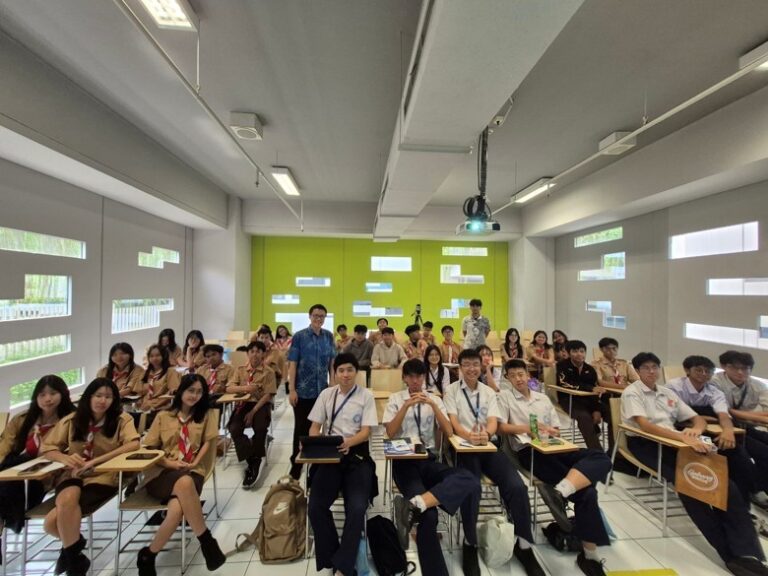
Held at the BINUS University@Alam Sutera Campus on 2 September 2026, the activity, titled “Think Like an Industrial Engineer: Can You Improve the System?”, welcomed high school students from SMA Regina Pacis Jakarta, SMA Tarsisius 2, and SMA Santo Kristoforus 2. The session combined a case-based exercise focused on improving an existing system and an immersive Virtual Reality (VR) experience that introduced students to the 5S concept through a virtual hands-on opportunity to practice its application in a factory environment using a VR headset and controller.
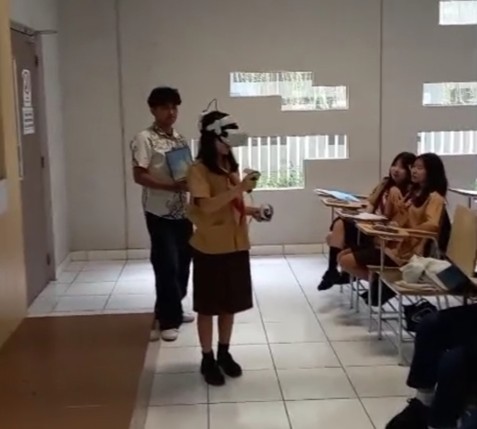
The activity is part of the Industrial Engineering Department’s ongoing effort, led by the Head of Department, Dr. Ir. Rienna Oktarina, S.T., M.T., CSCA., to introduce and disseminate the concept of Industrial Engineering to a wider audience. Through community engagement activities such as this, the department seeks to make Industrial Engineering more accessible and relatable to students and the broader community.
Designed as an introductory trial class, the activity provided students with an opportunity to explore Industrial Engineering through practical activities while gaining insight into how industrial engineers approach real-world challenges. The session was delivered entirely in English, providing students with an opportunity to engage with Industrial Engineering concepts in an English-language academic setting.
The session was led by Aditya Andika, S.T., M.B.A., an Industrial Engineering lecturer at BINUS University, together with Zaidan Indityo Muflih, an Industrial Engineering Laboratory Assistant.
At the heart of the session was a simple but important question: “Can you improve the system?”
Students were introduced to the idea that Industrial Engineering is about understanding how different parts of a system work together and designing those interactions to make the system better. People, processes, technology, and data are not viewed as separate elements; instead, industrial engineers consider how these elements can work together effectively to achieve better outcomes.
Industrial engineers design how the parts of a system work together. They look at the relationships between people and processes, the role of technology, the information and data used to make decisions, and the way these elements interact within a larger system.
As part of the session, students worked on a case involving an existing system that could be improved. Rather than being asked to create a completely new system, students were encouraged to examine the current system, identify areas for improvement, and think about how its different components could work together more effectively. The exercise demonstrated that improvement is not always about changing one component. Sometimes, the key is to redesign the way different parts of the system interact.
Through the case activity, students began to experience the mindset of an industrial engineer: looking at the bigger picture, asking questions, analyzing relationships, and considering how people, processes, technology, and data can work together to create a better system.
One of the highlights of the activity was the Virtual Reality (VR) experience focused on 5S in a factory environment. Through the VR experience, students were introduced to the 5S principles: Sort, Set in Order, Shine, Standardize, and Sustain. They then had the opportunity to enter a virtual factory environment and apply the 5S principles through a hands-on simulation.
Rather than learning about 5S solely through explanation, the VR experience allowed students to interact with the simulated factory environment and experience how 5S can be implemented in practice. The immersive approach transformed the concept into a tangible learning experience and gave students an opportunity to see how workplace organization can contribute to a better-performing system.
During the activity, students took turns experiencing the VR environment, while the other participants continued working on the case exercise. This arrangement allowed students to participate in both activities and remain actively engaged throughout the session.
The combination of case-based problem solving and virtual hands-on learning provided students with complementary perspectives on Industrial Engineering. The case exercise encouraged them to evaluate an existing system and develop ideas for improvement, while the VR experience allowed them to put the 5S concept into practice in a simulated industrial environment.
For the participating high school students, the activity also provided an opportunity to experience a university learning environment firsthand. Conducting the session in English added another dimension to the experience, allowing students to engage with academic and technical concepts in English.
The interactive format allowed students to explore a potential field of study while discovering how analytical thinking, creativity, communication, technology, and data can come together to improve existing systems.
More than simply introducing students to a field of study, the activity encouraged them to adopt a mindset of continuous improvement: look at the system, understand how its parts work together, and ask how it can be made better.
Ultimately, the message of the session was captured in its central question:
Can you improve the system?

Comments :