


The Transition Toward Circular Manufacturing and Sustainable Industrial Operations
(Source : AI Generated)
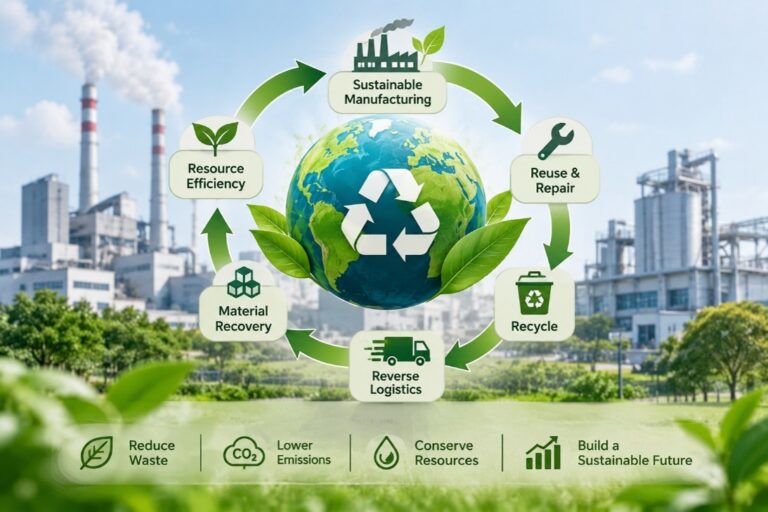
The manufacturing industry plays an important role in economic development by transforming raw materials into products that meet the needs of society. However, existing conventional manufacturing systems still rely on a linear production model, which involves the extraction of resources, processing, consumption, and eventually disposal as waste. This approach can lead to excessive resource consumption, increased production waste, and environmental degradation. As industries continue to develop, companies are facing greater pressure to improve operational efficiency while simultaneously reducing their environmental impact. One approach that has gained increasing attention is the circular economy, which is a concept that encourages the sustainable use of resources and materials through reuse, repair, recycling, and material recovery activities. The transition toward circular manufacturing requires the integration of sustainability principles into production processes, product design, and supply chain activities. Therefore, circular manufacturing is not only an effort to preserve the environment but also an approach to creating more efficient and sustainable industrial systems.
Circular manufacturing involves various practices aimed at extending the useful life of products, components, and materials. These practices include product reuse, repair, refurbishment, remanufacturing, and recycling. Each method has a different level of resource recovery. For example, repair and refurbishment activities allow companies to extend the lifespan of their products without having to replace existing components. Meanwhile, remanufacturing refers to the process of restoring used products or components through several stages, such as inspection, disassembly, component replacement, and testing to ensure that the products meet established quality standards. Recycling is also an important practice, particularly when a product can no longer be reused or repaired. However, recycling is not always the primary solution because repair and remanufacturing activities can preserve more of the value contained in existing products or components. These practices demonstrate that manufacturing companies can reduce their dependence on new raw materials while maintaining resource value throughout the production cycle.
Another important aspect of implementing circular manufacturing is reverse logistics, which refers to the process of moving products and materials from consumers back to manufacturers or designated processing facilities. Unlike conventional logistics systems, which primarily focus on delivering finished products to consumers, reverse logistics manages returned products through inspection, sorting, repair, refurbishment, remanufacturing, and recycling processes. An effective reverse logistics system enables companies to identify products that can still be utilized and determine the most appropriate recovery methods. Furthermore, material recovery and the concept of industrial symbiosis provide opportunities to reduce industrial waste by utilizing materials that were previously considered unusable. Industrial symbiosis itself refers to a form of cooperation between companies involving the exchange of by-products, waste materials, energy, or other resources that can be used as supporting materials in another company’s industrial processes. Through these practices, companies can improve resource utilization, reduce waste disposal activities, and establish better cooperation throughout the supply chain. Therefore, circular manufacturing requires companies to focus not only on their internal production activities but also on the movement and utilization of resources throughout the entire lifecycle of their products or components.
The development of digital technologies also creates new opportunities to support the transition toward circular manufacturing. Various technologies associated with Industry 4.0, such as the Internet of Things (IoT), Artificial Intelligence (AI), robotics, data analytics, and digital twins, can improve the monitoring and management of industrial activities. For example, IoT devices and tracking systems can provide information regarding product conditions, material composition, and resource locations throughout the supply chain. This information can help companies improve product traceability and make more appropriate decisions regarding material recovery. Meanwhile, AI and predictive maintenance systems can analyze operational data to identify potential equipment failures, estimate the remaining useful life of machinery, and determine appropriate maintenance schedules. Automation and robotics can also support material sorting, product inspection, and component disassembly, allowing recovery processes to operate more consistently and efficiently. In addition, digital twin technology enables companies to simulate production conditions and evaluate various operational scenarios before implementing changes in actual manufacturing environments. Nevertheless, adopting these technologies does not automatically create a circular production system. Their effectiveness still depends on data quality, organizational capabilities, and the level of integration between digital technologies and the company’s sustainability objectives.
Despite offering various potential benefits, the implementation of circular manufacturing still faces several challenges for industrial companies. One of the main obstacles is the financial investment required to develop material recovery facilities, redesign products, establish reverse logistics networks, and adopt digital technologies. These costs can become significant barriers, particularly for small and medium-sized enterprises with limited financial resources. Technical challenges may also arise when returned products have different conditions, material compositions, and levels of usability, making inspection, sorting, and recovery processes more complex. Furthermore, organizational readiness plays an important role because circular manufacturing requires coordination across various departments, including production, procurement, maintenance, quality control, logistics, and product development. Companies may also face challenges related to uncertain market demand for repaired or remanufactured products, low consumer acceptance, and inconsistent regulations. Without adequate cooperation among manufacturers, suppliers, logistics service providers, and other stakeholders, circular economy initiatives risk remaining limited to specific activities rather than becoming part of an integrated industrial system. Therefore, successful implementation requires a combination of financial planning, technological development, workforce readiness, and effective supply chain coordination.
The transition toward circular manufacturing represents an important development in creating more sustainable and efficient industrial operations. Through the implementation of various practices, such as product reuse, repair, remanufacturing, reverse logistics, and material recovery, companies can reduce resource consumption while maintaining material value throughout the product lifecycle. The integration of digital technologies can further support these efforts by improving production monitoring, material traceability, maintenance planning, and operational decision-making. However, achieving a circular manufacturing system cannot be accomplished solely by adopting new technologies or implementing recycling programs. Companies must also improve production planning, optimize material flows, minimize waste, and enhance overall operational performance. In the future, manufacturing companies that successfully integrate circular economy principles into their business and production strategies may have a stronger competitive advantage in addressing environmental challenges and adapting to an increasingly competitive industrial landscape.
References
- Mansouri, A., Bennis, I., Siadat, A., & Akef, F. (2026). Transitioning Manufacturing Toward Circular Economy A systematic Review of Practices, Digital Enablers, and Implementation Barriers. Circular Economy and Sustainability, 1-25.
Comments :