


Circular Economy and Sustainable Manufacturing: The Emerging Focus of Industrial Engineering
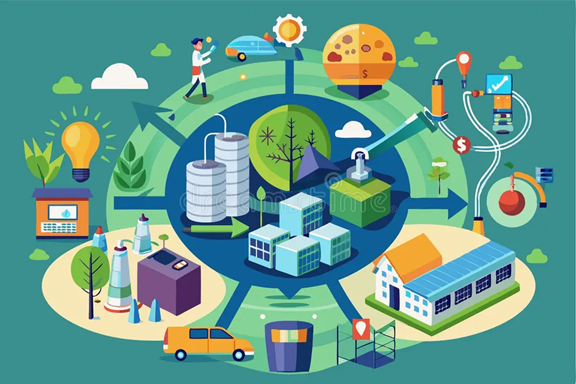
Industrial engineering is increasingly shifting toward sustainability and circular economy practices as industries face rising environmental pressures, resource limitations, and stricter regulations. In recent years, manufacturing companies around the world have started redesigning production systems to reduce waste, improve resource efficiency, and create environmentally responsible operations. This transformation has made sustainable manufacturing one of the most important contemporary topics in industrial engineering.
The traditional manufacturing model follows a linear pattern in which raw materials are extracted, transformed into products, and eventually discarded after use. However, this approach generates excessive waste and contributes to environmental degradation. To address these challenges, industrial engineers are now promoting circular economy principles that emphasize reuse, recycling, remanufacturing, and resource recovery. Research published in the Journal of Industrial Ecology explains that sustainable product design is becoming essential because decisions made during the design phase strongly influence a product’s environmental impact throughout its lifecycle.
Another major trend is the integration of Industry 5.0 concepts into manufacturing systems. Unlike Industry 4.0, which mainly focused on automation and digital connectivity, Industry 5.0 emphasizes collaboration between humans and intelligent technologies while maintaining sustainability goals. Recent studies indicate that manufacturers are beginning to combine artificial intelligence, robotics, and smart systems with human-centered operational strategies. This approach aims not only to improve efficiency but also to create resilient and environmentally conscious production systems.
Sustainable manufacturing also involves optimizing energy consumption and reducing industrial emissions. Modern industrial engineering practices increasingly utilize predictive maintenance, energy monitoring systems, and intelligent scheduling to minimize unnecessary resource use. Researchers have noted that manufacturing industries can significantly improve sustainability performance by integrating smart production planning with circular resource management. Such systems allow companies to reduce material waste while maintaining operational productivity.
In addition, reverse logistics has become an important component of industrial engineering. Companies are now designing supply chains that allow products and materials to return to the production cycle after use. This process includes product refurbishment, remanufacturing, and recycling activities. Through reverse logistics systems, industries can extend product life cycles and reduce dependence on virgin raw materials. According to recent industrial engineering research, sustainable production management supported by circular supply chains improves long-term operational resilience and cost efficiency.
Human-centered manufacturing is another critical aspect of current industrial engineering development. As industries adopt advanced technologies, engineers are expected to balance automation with workforce well-being and organizational adaptability. Studies published in 2025 emphasize that future industrial systems should prioritize collaboration between workers and intelligent technologies rather than fully replacing human roles. This perspective aligns with the broader goals of Industry 5.0, where technology serves to support human creativity, flexibility, and decision-making.
Furthermore, industrial companies are increasingly pressured to meet Environmental, Social, and Governance (ESG) standards. As a result, industrial engineers are involved not only in productivity improvement but also in sustainability reporting, carbon reduction strategies, and green manufacturing initiatives. The growing global focus on decarbonization has encouraged industries to redesign manufacturing systems that are more energy-efficient and environmentally responsible. Sustainable manufacturing is therefore no longer viewed as an optional initiative, but rather as a strategic necessity for long-term competitiveness.
Overall, the future of industrial engineering is strongly connected with sustainable manufacturing and circular economy implementation. Industrial engineers are expected to develop multidisciplinary capabilities that combine operations management, sustainability analysis, digital technology, and human-centered system design. As industries continue transitioning toward greener production systems, industrial engineering will play a vital role in building manufacturing environments that are efficient, resilient, and sustainable.
References:
- Klose, S. A., & Fröhling, M. (2025). A New Circular Economy Conception for Sustainable Product Design. Journal of Industrial Ecology.
- Rejeb, A., Rejeb, K., Keogh, J. G., & Süle, E. (2025). When Industry 5.0 Meets the Circular Economy: A Systematic Literature Review. Circular Economy and Sustainability.
- Shabur, M. A., Shahriar, A., & Ara, M. A. (2025). From Automation to Collaboration: Exploring the Impact of Industry 5.0 on Sustainable Manufacturing. Discover Sustainability.
- Setyadi, A., et al. (2025). Trends and Opportunities in Sustainable Manufacturing: A Systematic Review of Key Dimensions from 2019 to 2024. Sustainability.
- Noor, Z. Z. (2025). Sustainable Production Management in Circular Economy Supply Chains. International Journal of Industrial Engineering and Management.
- Jirkovský, V., et al. (2025). Towards Resilient and Sustainable Global Industrial Systems: An Evolutionary-Based Approach. arXiv.
- TechRadar Pro. (2025). Engineers for the Future: Championing Innovation Through People, Purpose and Progress.

Comments :