



Artificial Intelligence for Smarter Facility Layout Optimization
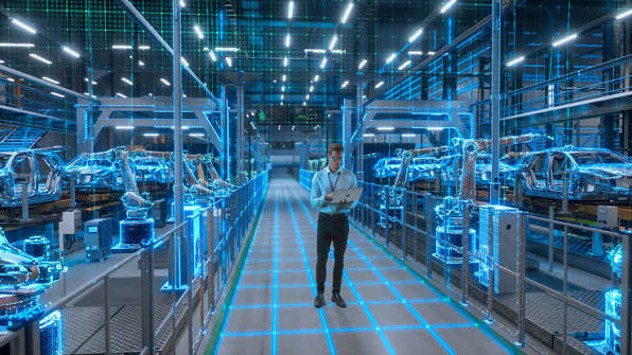
(Source: qualitymag.com)
In the era of Industry 4.0, Artificial Intelligence (AI) is increasingly transforming how industrial systems are designed, analyzed, and optimized. One area where AI can provide significant benefits is facility layout planning, an important aspect of Industrial Engineering. A well-designed facility layout determines how machines, workstations, storage areas, and other facilities are positioned within a production environment. This arrangement directly affects material flow, transportation distance, operational costs, production efficiency, and workplace safety.
Facility layout planning is closely related to subjects such as Facility Planning and Safety Engineering, Deterministic Optimization, and Production & Operation Analysis in Industrial Engineering. Traditionally, engineers develop layout alternatives by analyzing material flow, space requirements, relationships between departments, and material handling costs. However, as manufacturing systems become more complex, evaluating a large number of possible layouts manually can become time-consuming. This creates an opportunity for AI to support engineers in exploring and evaluating different layout configurations more efficiently.
AI can be applied to facility layout optimization by analyzing production data and generating alternative arrangements based on predefined objectives and constraints. One promising approach is Deep Reinforcement Learning, where an AI agent learns which decisions can lead to better solutions. Research has demonstrated that reinforcement learning can be used to optimize facility layouts while considering factors such as material handling costs and production requirements. These approaches show how AI can help engineers explore solutions that may be difficult to identify through conventional methods.
The benefits of AI become even more relevant when production conditions change. Modern manufacturing environments often need flexible layouts because product variety, production volumes, and customer requirements can change over time. By combining AI with technologies such as simulation, Digital Twins, and Industrial Internet of Things (IIoT), engineers can evaluate different layout scenarios before making physical changes to a facility. This allows potential improvements to be tested digitally, reducing the risks and costs associated with layout changes.
For example, an AI-assisted system could analyze the movement of materials between machining, assembly, inspection, and storage areas. Based on this information, the system could generate several layout alternatives and identify configurations that reduce unnecessary material movement. However, the AI-generated solution still needs to be evaluated by an Industrial Engineer. A layout that performs well mathematically may not necessarily be the safest, easiest to maintain, or most suitable for workers.
Therefore, AI should be viewed as a decision-support tool rather than a replacement for Industrial Engineers. Engineers remain responsible for defining objectives, establishing constraints, evaluating practical considerations, and validating the final solution. This combination of engineering knowledge and AI can make facility planning more efficient while maintaining considerations such as safety, accessibility, flexibility, and future expansion.
The integration of AI into facility planning demonstrates how Industrial Engineering is evolving alongside Industry 4.0. For future Industrial Engineers, understanding traditional concepts such as material flow, optimization, production systems, and safety will remain essential, while knowledge of AI and data analysis can provide additional capabilities. By combining these skills, Industrial Engineers can design facility layouts that are not only more efficient, but also more flexible and responsive to the changing needs of modern manufacturing.
References:
- Arnarson, H., Yu, H., Olavsbråten, M. M., Bremdal, B. A., & Solvang, B. (2023). Towards smart layout design for a reconfigurable manufacturing system. Journal of Manufacturing Systems, 68, 354–367.
- Gao, R. X., Krüger, J., Merklein, M., Möhring, H.-C., & Váncza, J. (2024). Artificial intelligence in manufacturing: State of the art, perspectives, and future directions. CIRP Annals, 73(2), 723–749.
- Heinbach, B., Burggräf, P., & Wagner, J. (2023). Deep reinforcement learning for layout planning – An MDP-based approach for the facility layout problem. Manufacturing Letters, 38.

Comments :